
Models / Explained
The ECMWF IFS weather model
The ECMWF IFS is the global weather model of the European Centre for Medium-Range Weather Forecasts, often called the Euro. Its deterministic forecast has about 9 kilometer resolution, runs 10 days ahead in the open data 4070 uses, and is one of the two global models most forecasters check first. Since May 2026 it runs as one control forecast and no longer as a separate HRES run.
By Weather Decision Solutions. Published . Updated .
At a glance
| Item | Detail |
|---|---|
| Produced by | ECMWF, the European Centre for Medium-Range Weather Forecasts, an independent intergovernmental organization |
| Type | Global deterministic model, the control forecast of the ensemble |
| Resolution | About 9 km with 137 levels. The open data 4070 uses is on a 0.25 degree grid. |
| Forecast range | 10 days (240 hours) for the deterministic forecast in ECMWF open data |
| Runs | 00Z and 12Z are the main runs; 06Z and 18Z are shorter runs in open data |
| Current version | IFS cycle 50r1, operational since May 12, 2026, with fully coupled ocean and atmosphere forecasts |
| New runs in 4070 | 00Z and 12Z |
What ECMWF IFS is
The IFS is the Integrated Forecasting System, the model at the heart of ECMWF. In everyday talk it is simply the Euro, and when a forecaster says the Euro and the GFS disagree about a storm, they mean the IFS and NOAA’s Global Forecast System.
For years, ECMWF ran a separate high-resolution forecast called HRES. With cycle 50r1, which became operational on May 12, 2026, ECMWF stopped running HRES and the ensemble control separately, because the previous cycle had already made them identical, so one control forecast remains. Older articles and charts still say HRES, and in current open data the deterministic forecast carries the label "oper". Cycle 50r1 also switched to fully coupled ocean and atmosphere forecasts, with a new ocean and sea-ice configuration, and changed the convection scheme.
The resolution of about 9 kilometers is finer than the GFS’s 13 kilometers, and the IFS is a physics-based model, in contrast to ECMWF’s machine-learning AIFS. ECMWF publishes an open data set of IFS and AIFS output on a 0.25 degree grid under a CC-BY-4.0 license, which is what 4070 shows.
Where it does well
- It is one of the two global models most forecasters check first, and a standard second opinion whenever the GFS shows something unusual.
- A finer grid than the GFS, so it can draw fronts and storm structure in more detail.
- It is a physics-based model with a long record, so forecasters know how it behaves.
- Open data for 4070’s views includes the fields forecasters check most: precipitation, temperature, wind, 850 and 500 mb, CAPE, cloud cover, precipitable water and precipitation type.
Where it falls short
- It runs the main forecast twice a day in 4070, at 00Z and 12Z, so it updates less often than the GFS.
- The open data set carries a subset of fields, at 0.25 degree. Some maps that exist for the GFS do not exist here.
- The deterministic forecast in open data runs 10 days, shorter than the GFS’s 16.
- A single IFS run is one run. Compare it with the previous run and with the ensemble.
What it is typically used for
- The large-scale pattern and storm tracks three to ten days out.
- A tiebreaker or comparison when the GFS looks unusual.
- Checking precipitation type and snowfall guidance, with the usual snow ratio caution.
- Comparing runs: has the Euro been steady or shifting from run to run?
How to see ECMWF IFS in 4070
The ECMWF model is in Model Explorer under Global Models, with 00Z and 12Z runs. It is part of 4070 Pro, which starts with a seven-day free trial.
- Fields include a classic precipitation, MSLP and temperature view, precipitation, 2 meter temperature, 10 meter wind, 850 hPa temperature, 500 mb heights and wind, 500 hPa vorticity, 250 hPa wind, dew point, wind gust, CAPE, cloud cover, precipitable water, precipitation type and snowfall guidance drawn by WDS.
- Regions include North America, the United States, Europe and the Northern and Southern Hemispheres.
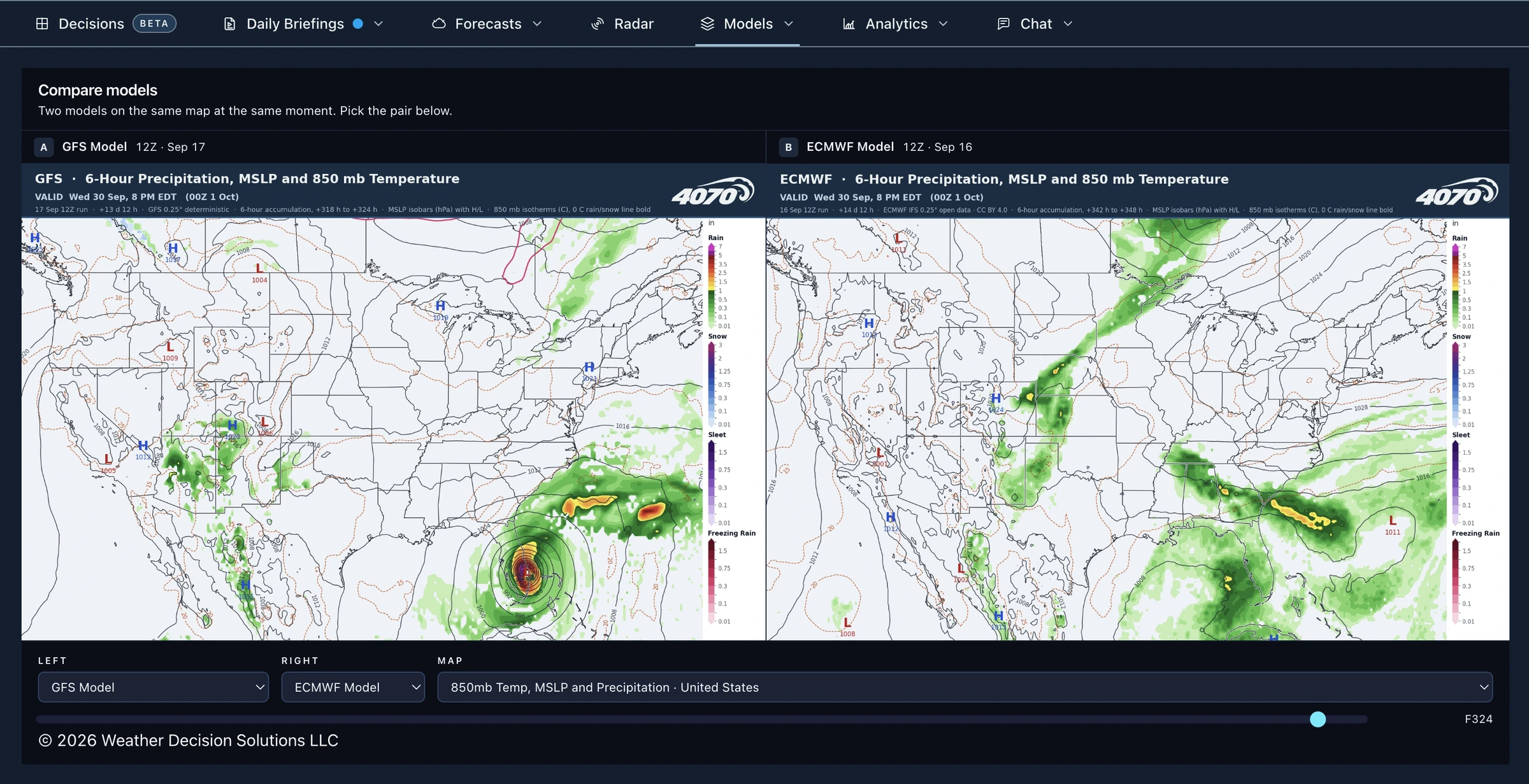
- Compare Models puts the ECMWF beside the GFS or another compatible model at the same valid time. Each panel names its own run, so the runs can differ while the moment does not.
- Plumes include the three most recent ECMWF runs at a U.S. point.
How it fits with the other models
The GFS is the other global model forecasters check first. The IFS has a finer grid, the GFS runs more often and goes out 16 days. The ECMWF EPS is the ensemble built from the same system, and the AIFS is ECMWF’s machine-learning model. Read two or three together. Our guide to model accuracy explains why no one model leads in every season and every region.
Specifications change when agencies upgrade their models. The Sources below link to the producing agency. Official National Weather Service forecasts, watches and warnings remain the authority for what is expected where you live.
Common questions
What is the ECMWF IFS?
The IFS, or Integrated Forecasting System, is the global weather model of the European Centre for Medium-Range Weather Forecasts. It is commonly called the Euro, and its deterministic forecast has about 9 kilometer resolution and runs 10 days ahead in ECMWF open data.
Is the Euro the same as the ECMWF?
Yes. Forecasters use the Euro as a nickname for the ECMWF IFS model. It is made by the European Centre for Medium-Range Weather Forecasts, an intergovernmental organization.
What happened to ECMWF HRES?
With IFS cycle 50r1, operational on May 12, 2026, ECMWF stopped running HRES and the ensemble control separately, because cycle 49r1 had already made them identical. One control forecast remains, which carries the label oper in open data.
How often does the ECMWF run?
The main runs are at 00Z and 12Z, and shorter runs at 06Z and 18Z exist in the open data. In 4070, new ECMWF runs appear for 00Z and 12Z.
Is the ECMWF better than the GFS?
It depends on the variable, lead time, region and season. The IFS has a finer grid and the GFS runs more often and goes out further. In 4070, Compare Models shows both at the same valid time, and Model Scorecard in 4070 Pro shows how the models compared with the nearby weather station at each of your saved locations over recent days.
Where can I see the ECMWF in 4070?
In Model Explorer under Global Models, in Compare Models and in Plumes. These tools are part of 4070 Pro, with a seven-day free trial.
Sources
- ECMWF, Implementation of IFS cycle 50r1. Cycle 50r1 became operational May 12, 2026, with fully coupled ocean-atmosphere forecasts and convection changes; HRES and the ensemble control, made identical in cycle 49r1, are no longer run separately.
- ECMWF, Changes to the ECMWF model. The history of IFS cycles, including cycle 50r1 on May 12, 2026.
- ECMWF, Open data. The open data set is 0.25 degree, GRIB2, CC-BY-4.0 licensed, and includes IFS and AIFS output; the deterministic (oper) stream runs to 240 hours at 00 and 12 UTC.
- NCEP EMC, Global Forecast System. GFS runs four times a day to 16 days at about 13 km with the FV3 core; GFSv16 was implemented March 22, 2021.
See ECMWF IFS in 4070.
Model Explorer, Compare Models and Plumes are part of 4070 Pro. Start with seven days free, then $14.95 a month.